
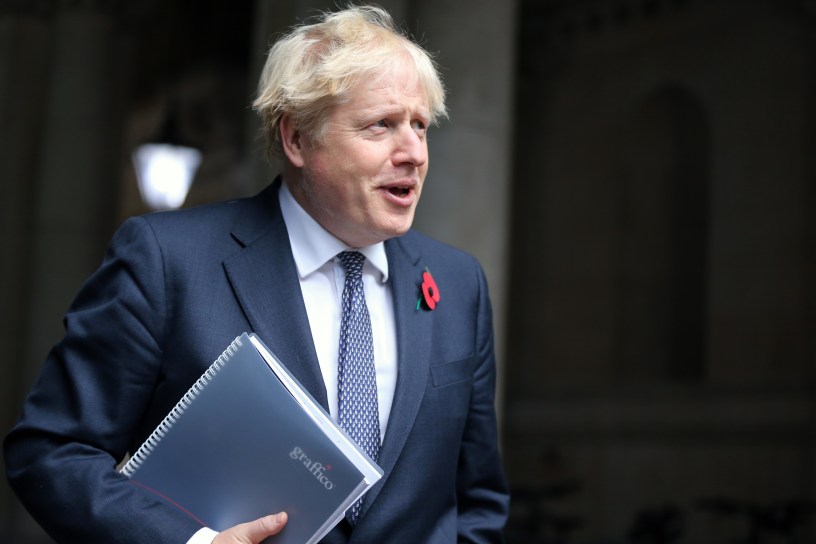
Boris Johnson was a British politician who served as the prime minister of the United Kingdom from 2019 to 2022. He was also the leader of the Conservative Party, the foreign secretary, and the mayor of London. He was known for his charisma, his populist appeal, and his controversial role in Brexit.
Johnson was born in New York City in 1964 to British parents. He grew up in London and Brussels, and attended Eton College and Oxford University. He started his career as a journalist, working for The Times, The Daily Telegraph, and The Spectator. He became a political columnist and an editor and gained a reputation for his witty and provocative style.
Johnson entered politics in 2001, when he was elected as a member of parliament for Henley. He joined the Conservative Party and held various shadow cabinet positions under Michael Howard and David Cameron. He became the mayor of London in 2008, defeating the incumbent Ken Livingstone. He was re-elected in 2012, and oversaw the successful hosting of the 2012 Summer Olympics.
Johnson returned to parliament in 2015, representing Uxbridge and South Ruislip. He became one of the leading figures of the Leave campaign in the 2016 referendum on the UK’s membership of the European Union. He argued that leaving the EU would restore British sovereignty, democracy, and prosperity. He also clashed with then prime minister Cameron, who supported Remain.
After the referendum resulted in a narrow victory for Leave, Cameron resigned and Johnson was expected to run for the leadership of the Conservative Party and the premiership. However, he withdrew from the race after his ally Michael Gove announced his own candidacy, accusing Johnson of lacking leadership qualities.
Johnson was appointed as foreign secretary by Theresa May, who became the new prime minister. He faced criticism for his diplomatic gaffes, his lack of attention to detail, and his disloyalty to May. He resigned in 2018 over May’s Brexit deal with the EU, which he called a “betrayal” of the referendum result.
Johnson launched his second bid for the leadership of the Conservative Party and the premiership in 2019, after May stepped down following her failure to get her Brexit deal approved by parliament. He won the contest with a large majority of votes from party members, promising to deliver Brexit by October 31, 2019, “do or die”.
Johnson became the prime minister in July 2019. He faced a hostile parliament that rejected his attempts to force through a no-deal Brexit or call an early election. He also faced legal challenges over his decision to suspend parliament for five weeks, which was ruled unlawful by the Supreme Court.
Johnson managed to renegotiate a new Brexit deal with the EU in October 2019, which removed the controversial Irish backstop and created a customs border between Northern Ireland and Great Britain. He finally secured an election in December 2019, which he won with a landslide majority of 80 seats.
Johnson delivered Brexit on January 31, 2020, ending 47 years of UK’s membership of the EU. He then entered into negotiations with the EU over their future relationship, which resulted in a trade and cooperation agreement that was signed on December 24, 2020.
Johnson also faced the challenge of dealing with the COVID-19 pandemic, which hit the UK hard in early 2020. He imposed several lockdowns and restrictions to contain the virus, which caused severe economic and social damage. He also contracted COVID-19 himself in March 2020 and spent three nights in intensive care.
Johnson oversaw a successful vaccination program that began in December 2020 and reached over half of the UK population by June 2021. He also hosted the G7 summit in Cornwall in June 2021, where he discussed issues such as climate change, global health, and China with other world leaders.
Johnson’s personal life also attracted attention during his time as prime minister. He divorced his second wife Marina Wheeler in 2020 after a long separation. He married his third wife Carrie Symonds in May 2021 at Westminster Cathedral. He has seven children from his three marriages and other relationships.
Johnson’s premiership came to an abrupt end in September 2022 after he was embroiled in a series of scandals involving alleged breaches of COVID-19 rules at Downing Street parties during lockdowns. He also faced accusations of cronyism, corruption, and lying to Parliament over various issues.
Johnson resigned as prime minister on September 6, 2022, after losing a vote of no confidence from his own party MPs. He was succeeded by Liz Truss, who became the second female prime minister of the UK. Johnson also resigned as an MP on June 12, 2023, after being investigated by a parliamentary committee over his conduct.
Johnson was one of the most influential and divisive figures in British politics in recent history
 politicalchinwag.politics.blog